Key takeaways
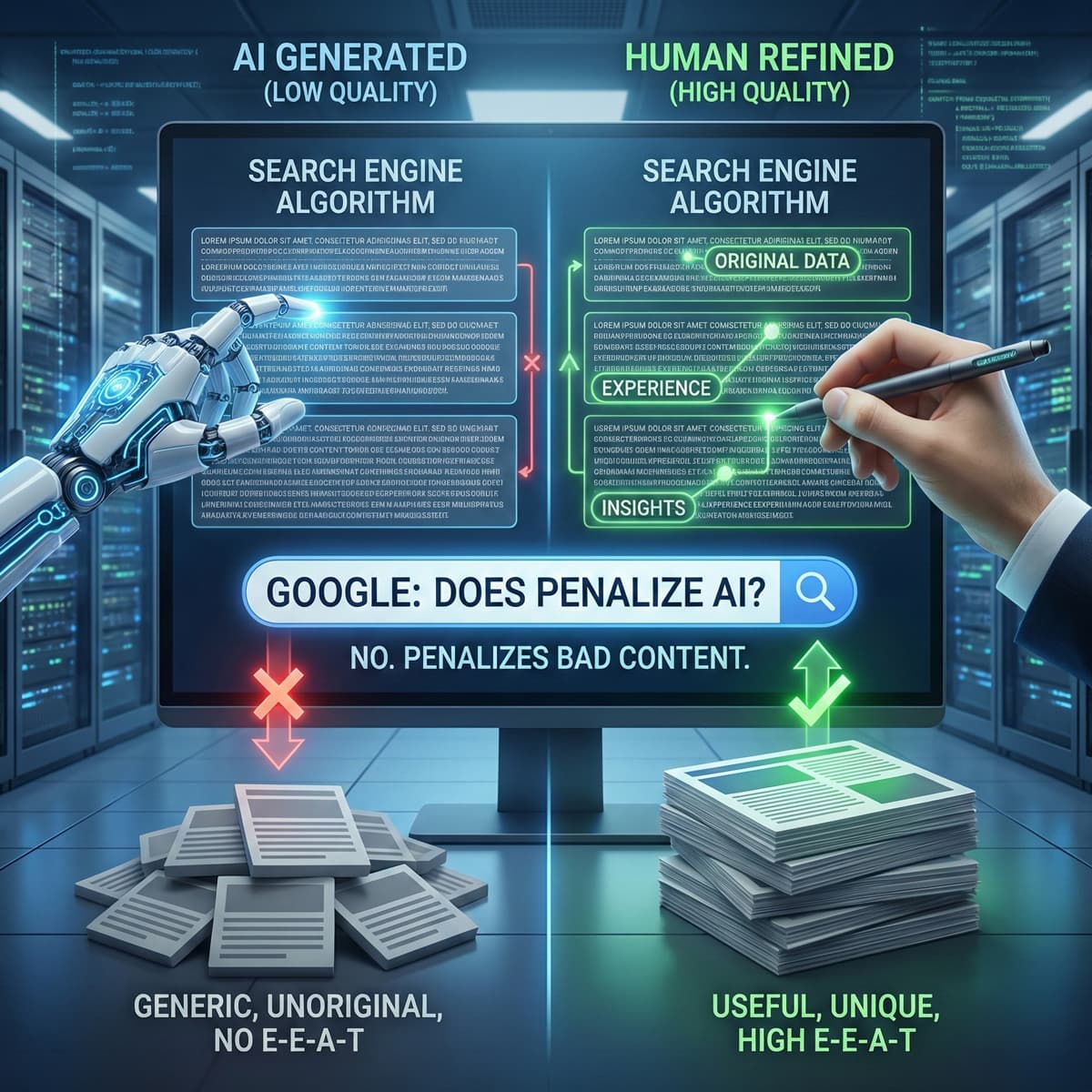
- Google doesn't penalize AI-generated content specifically; it penalizes low-quality content regardless of who or what wrote it
- The March 2024 core update cut low-quality content in search results by 45% and deindexed hundreds of AI spam sites
- 60% of Google searches now end with zero clicks, making content quality more important than ever
- AI content that ranks needs original data, specific experience, or a perspective the AI couldn't generate on its own
The short answer
Google doesn't care if AI wrote your content. Google cares if your content is useful.
That's the official position, and it's been consistent since 2023. But the nuance matters, because "useful" has a specific meaning in Google's ranking systems, and most AI content fails the test.
What Google actually said
Google's Search Liaison Danny Sullivan and Search Advocate John Mueller have both addressed this directly. The message hasn't changed: the method of content production doesn't determine ranking. The quality does.
Google's helpful content system evaluates whether content was written for people or for search engines. It doesn't check if a human typed every word. It checks whether the content provides value that the searcher can't easily get elsewhere.
This sounds like good news for AI content. It's not, really. Because most AI content fails that "can't easily get elsewhere" test.
What the algorithm updates actually did
March 2024 core update
This was the big one. Google rolled it out over 45 days (March 5 to April 19, 2024) and called it more complex than usual: changes to multiple core systems simultaneously.
The results were specific: a 45% reduction in low-quality, unoriginal content in search results. Hundreds of websites were deindexed entirely in the first weeks. Google explicitly targeted content created primarily for search engines rather than for people.
The sites that got hit shared a pattern: high-volume AI content with minimal or no human editing. Article farms that published 50+ posts per day. Sites where every article followed the same AI-generated template.
2025 updates
The December 2025 core update expanded E-E-A-T requirements to all comparative searches: ecommerce reviews, SaaS comparisons, how-to guides. Sites without demonstrated expertise saw ranking drops of 40-60%.
The message was consistent: Google's systems are getting better at distinguishing genuinely helpful content from AI-generated filler.
The zero-click problem
Here's a number that matters more than any algorithm update: 60% of Google searches now end with zero clicks. The searcher gets their answer from Google's AI Overviews or featured snippets without ever visiting a website.
Gartner projects a 25% drop in organic search traffic to websites by 2026. That's happening now.
This changes the calculus for content. If fewer searches result in clicks, the clicks you do get need to convert. Generic AI content doesn't convert. It doesn't differentiate you. It doesn't build trust.
Why AI content fails the quality test
I've read thousands of AI-generated articles. Here's what they have in common:
The same structure
AI models generate statistically likely content. For any given topic, the "likely" structure is the same across every model. Search for "best practices for email marketing" and read ten results. If they all cover the same five points in the same order, Google has no reason to rank yours.
No original data
AI can summarize existing data. It can't create new data. It can't run a customer survey. It can't analyze your Google Search Console. It can't report on what happened when you tested two different hero section layouts on your own site.
Original data is the single strongest differentiator for content in 2026. If your article contains data nobody else has, Google wants to surface it.
No experience
Google's E-E-A-T framework includes "Experience," the first E. Has the author actually done the thing they're writing about?
AI hasn't done anything. It hasn't built a website. It hasn't recovered a hacked WooCommerce store. It hasn't watched a client's conversion rate jump after a redesign. When we write about what happens when a store gets hacked, that's from experience. AI can only paraphrase what others have reported.
Hedging
AI hedges everything. "This can potentially lead to improved outcomes." "Consider evaluating whether this approach might be suitable." It doesn't commit to positions because it's designed to be balanced.
Content that ranks takes positions. "This is a bad approach for ecommerce stores." "Don't do this." "We tested it and it failed." Strong opinions backed by evidence are what people actually share and link to.
How to use AI for content without losing rankings
I use AI for every article I write. Including this one. Here's the process that works.
Step 1: AI for research and structure
Use AI to identify subtopics, find related questions, and suggest an outline. This replaces an hour of research with ten minutes.
But verify every factual claim independently. AI hallucinates data. It invents statistics. It attributes quotes to people who never said them. If you can't find the original source, drop the claim.
Step 2: AI for the first draft
Let AI write a draft based on your outline. This gives you raw material to work with, faster than starting from a blank page.
But don't start editing the AI draft directly. Read it, understand the shape of the argument, then rewrite it in your voice. If you edit the AI's draft, you end up with an article that's 80% AI and 20% human. If you rewrite using the draft as reference, you get an article that's 80% human with AI-informed structure.
Step 3: add what AI can't
This is the step most people skip. It's the one that determines whether your content ranks.
Add:
- Original data from your business, your clients, or your experiments
- Specific examples with names, numbers, and dates
- Your actual opinion on the topic, stated directly
- Experience-based insights that only come from doing the work
- Internal links to related content that builds topical authority
Step 4: remove AI fingerprints
Cut these patterns ruthlessly:
- Lists of exactly three things (AI loves the rule of three)
- Em dashes used for emphasis more than twice per article
- Sentences starting with "Furthermore," "Moreover," "Additionally"
- Vague attributions ("studies show," "experts agree," "according to research")
- Inflated language ("pivotal," "game-changing," "transformative")
- Conclusions that say nothing ("The future of X will continue to evolve")
These are markers that Google's systems may not explicitly flag, but they produce the kind of generic output that fails the helpfulness test.
Step 5: fact-check and attribute
Every statistic needs a source. Every claim needs evidence. If the AI says "30% of websites use WordPress," you need to verify that number and know where it comes from.
We link to original research, name the researchers, and cite the year. This is basic journalism. AI doesn't do it because AI doesn't know the difference between a real statistic and one it generated.
The content that actually ranks in 2026
Based on what I'm seeing in competitive niches:
Case studies with real numbers. "We redesigned this site and conversion rate went from 0.8% to 3.2%" ranks better than "redesigns can improve conversion rates."
Comparison content with original testing. Our AI website builders comparison includes actual PageSpeed scores from running each builder. That's data no AI can generate.
Contrarian takes with evidence. "AI website builders are a bad investment for most businesses" (backed by cost analysis and conversion data) earns more engagement than balanced articles that refuse to commit.
Tools and templates. Checklists, calculators, and templates get linked to from other sites. They provide utility that text articles don't.
Regional content. Articles targeting specific geographic markets (like South Africa) face less competition and serve a more specific audience. Every local business owner Googles "website cost in South Africa", and most results are AI-generated trash.
The honest position
AI content isn't dead. Unedited AI content is dead. There's a big difference.
Use AI to move faster. Use it to draft, research, and brainstorm. Then do the work that makes content worth ranking: add your experience, take a position, include data nobody else has, and write like a person who knows what they're talking about.
Google's algorithms will keep getting better at detecting valueless content. The solution isn't to hide AI usage; it's to use AI as a starting point, not a finish line.
Related reading
- AI and web development in 2026: what business owners actually need to know. The broader picture of AI in business, including content strategy.
- How we use AI at TurboPress. Our transparent breakdown of AI usage in content and code.
- How AI agents are replacing WordPress developers. The same principles apply to AI-generated code: speed from AI, quality from humans.
- Analytics that matter: sales funnel reports and conversion tracking. Good content without analytics is wasted effort. Here's what to track.