Key takeaways
- AI website builders can create functional sites in minutes, but they hit a wall fast
- Up to 30% of AI-generated code has security vulnerabilities
- AI doesn't understand your business, your customers, or your competitive advantage
- The businesses winning in 2026 use a hybrid approach: AI speed plus human strategy
- Knowing when to use AI and when to call in an expert is the real competitive edge
Let's Talk About the Elephant in the Room
You've seen the headlines. "Build a website in 60 seconds with AI." "No developers needed." "The end of web agencies."
And honestly? Some of it is true.
AI website builders have gotten shockingly good. You can type a prompt, wait a minute, and get a site with pages, images, copy, and even a contact form. For free, or close to it.
So the question every business owner is asking right now: Do I still need a web developer?
The answer is more nuanced than the headlines suggest.
What AI Can Actually Do in 2026
Let's give credit where it's due. AI tools have eliminated a massive amount of grunt work that used to cost businesses thousands of dollars.
Generate a Basic Website in Minutes
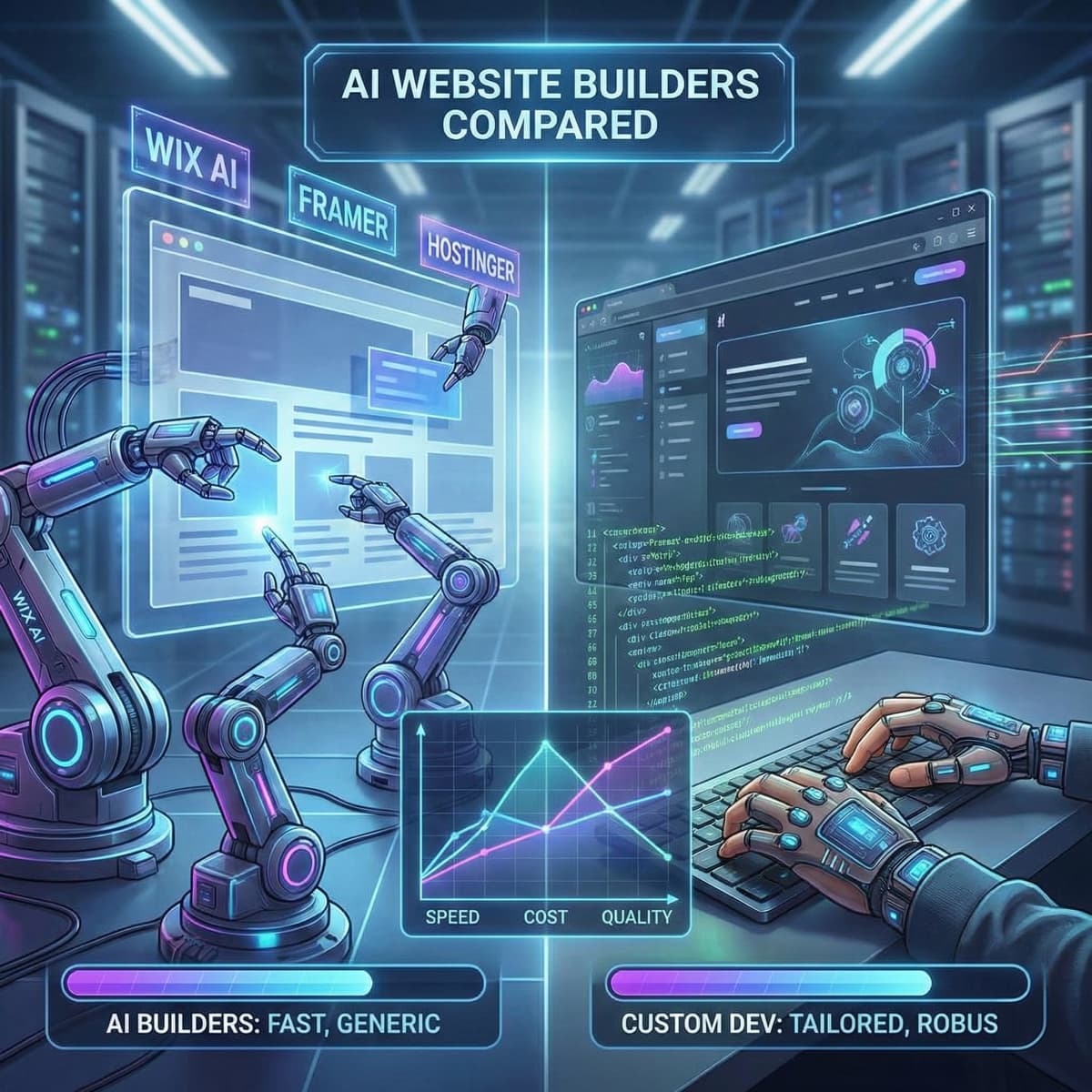
Tools like Wix AI Builder, Hostinger, and Framer can produce a working site from a single text prompt. You describe your business, pick a style, and the AI spits out a multi-page website. It's not perfect, but it's functional.
Write Decent First-Draft Copy
AI can generate headlines, product descriptions, and "About Us" pages that are... fine. They read well. They hit the right notes. They're a solid starting point.
Handle Repetitive Coding Tasks
For developers, AI tools like GitHub Copilot and Claude write boilerplate code, suggest fixes, and automate testing. According to Gartner, over 80% of web development tasks for customer-facing sites will be AI-assisted by 2026. That's not hype. That's the current reality.
Suggest SEO Metadata
AI can analyze your content and recommend title tags, meta descriptions, and basic keyword placement. Plugins like Rank Math AI and Yoast SEO already do this inside WordPress.
Where AI Falls Off a Cliff
Here's the part the AI companies don't put in their marketing.
It Doesn't Know Your Business
AI can build a website. It cannot build your website.
It doesn't know your customers, your competitors, your margins, or your sales process. It doesn't know that your ideal client is a 45-year-old operations manager who needs to see case studies before booking a call. It doesn't know that your checkout flow loses 40% of customers at the shipping options page.
Strategy requires context. AI has none.
The Code Has Problems
A study found that up to 30% of AI-generated code snippets contain security vulnerabilities. That's not a typo. Nearly one in three pieces of AI-written code could leave your site exposed.
AI also tends to produce bloated, unoptimized output. It works, but it's the equivalent of a house that passes inspection while having no insulation. You won't notice the problem until winter.
Templates Have a Ceiling
AI website builders rely on preset templates. You can tweak colors, fonts, and layout elements. But the moment you need something genuinely custom (a product configurator, a booking system that integrates with your CRM, a multi-step intake form), you hit a wall.
Complex ecommerce sites, web apps, and projects requiring backend logic will outgrow AI builders. It's not a matter of "if." It's "when."
SEO Is More Than Meta Tags
AI can suggest keywords. It cannot build a content strategy. It doesn't know which long-tail keywords your competitors are ignoring. It can't analyze your Google Search Console data and spot a topic cluster that would drive qualified traffic for the next 12 months.
SEO that drives revenue requires a human who understands both the technical and the strategic side.
The Real Question: AI Website Builder vs. Hiring a Web Developer
Let's break this down honestly.
Choose an AI Builder If:
- You need a simple brochure site to establish an online presence
- Your budget is under $500
- You don't rely on your website for revenue
- You're comfortable with a template that looks like thousands of other sites
- You don't need custom integrations or ecommerce
Hire a Developer (or Agency) If:
- Your website is a revenue-generating tool
- You sell products online and need a reliable checkout process
- You need third-party integrations (CRM, payment processors, booking systems)
- Page speed and Core Web Vitals affect your search rankings
- You need ongoing support, not just a launch
- You're in a competitive market where brand differentiation matters
- You handle sensitive customer data and need proper security
The cost difference is real. AI builders run $2 to $30 per month. Custom development starts at $5,000 and can reach $50,000 or more. But a website that converts at 3% instead of 0.5% will pay for itself many times over. The cheaper option isn't always the cheaper option.
What the Smart Businesses Are Doing
The companies winning in 2026 aren't picking sides. They're using a hybrid approach.
98% of small businesses plan to use AI tools for website development and digital presence this year. But the ones seeing real results aren't handing the keys to ChatGPT and walking away. They're pairing AI speed with human judgment.
Here's what that looks like in practice:
- AI generates the first draft. Content, layout ideas, code scaffolding. This cuts weeks of work down to hours.
- A strategist sets the direction. What pages do you need? What's the user journey? Where should the CTA go? These decisions require understanding your business.
- A developer handles the hard parts. Custom functionality, performance optimization, security, accessibility, integrations. The stuff AI can't do reliably.
- AI handles maintenance tasks. Content updates, basic monitoring, routine checks. This keeps ongoing costs low.
This is how you get a site that launches fast and performs well. Speed from AI. Quality from humans.
The Role of the Developer Is Changing
Web developers aren't disappearing. They're evolving.
Five years ago, a developer spent 60% of their time writing boilerplate code. Today, AI handles that. The developers worth hiring in 2026 spend their time on:
- Architecture decisions that affect performance and scalability
- Security hardening that protects your business and customer data
- Conversion optimization that turns traffic into revenue
- Integration work that connects your website to your business systems
- Problem-solving for the edge cases AI can't anticipate
The job title might still say "developer," but the actual work is closer to "technical strategist." And that's exactly what growing businesses need.
What This Means for Your Business
If you're a business owner reading this, here's the practical takeaway:
Don't fear AI. Don't blindly trust it either.
Use AI tools to move faster. Use them to generate ideas, draft content, and prototype designs. They're incredible for that.
But when it comes to the decisions that affect your bottom line (your site architecture, your conversion funnel, your checkout experience, your SEO strategy), bring in someone who understands the stakes.
The businesses that treat AI as a replacement for expertise will end up with generic, underperforming websites. The businesses that treat AI as a tool in the hands of experts will move faster and convert better than everyone else.
What to Do Next
Not sure where your website stands? Here's a quick self-audit:
- Check your conversion rate. If it's below 2%, your site has a strategy problem, not a design problem.
- Run a speed test. Paste your URL into Google PageSpeed Insights. If you're scoring below 70, you're losing visitors.
- Try to break your checkout. Go through your own buying process on a phone. If anything frustrates you, it's frustrating your customers.
- Ask yourself: "Could any competitor have this exact site?" If yes, you have a differentiation problem.
If any of those raised a flag, it might be time to talk to someone who can look at your specific situation and build a plan.
Related reading
- React vs WordPress in 2026. AI changes the equation, but you still need to pick the right technology for your business.
- From template site to high-performing asset: our website redesign playbook. Whether AI-assisted or human-built, the process for a great website is the same.