Key takeaways
- The headless CMS market is growing from $3.94B to $22.28B by 2034 -- this is a structural shift, not a trend
- Next.js powers 45% of production React applications and is the dominant frontend for headless architectures
- Decoupling your frontend from your CMS eliminates 60-70% of the security attack surface
- Headless architecture lets marketing teams publish without developer bottlenecks while keeping engineering quality high
- 81% of organisations plan zero-trust frameworks by 2026 -- headless architecture is a natural fit
The bottleneck nobody talks about
Ask an enterprise marketing team what frustrates them most about their website and you'll hear some version of the same complaint: "I can't publish anything without a developer."
Ask the development team and they'll say: "I spend half my time on CMS patches and plugin conflicts instead of building things that matter."
Ask the security team and they'll say: "Every plugin is a potential attack vector and nobody is keeping track of what's installed."
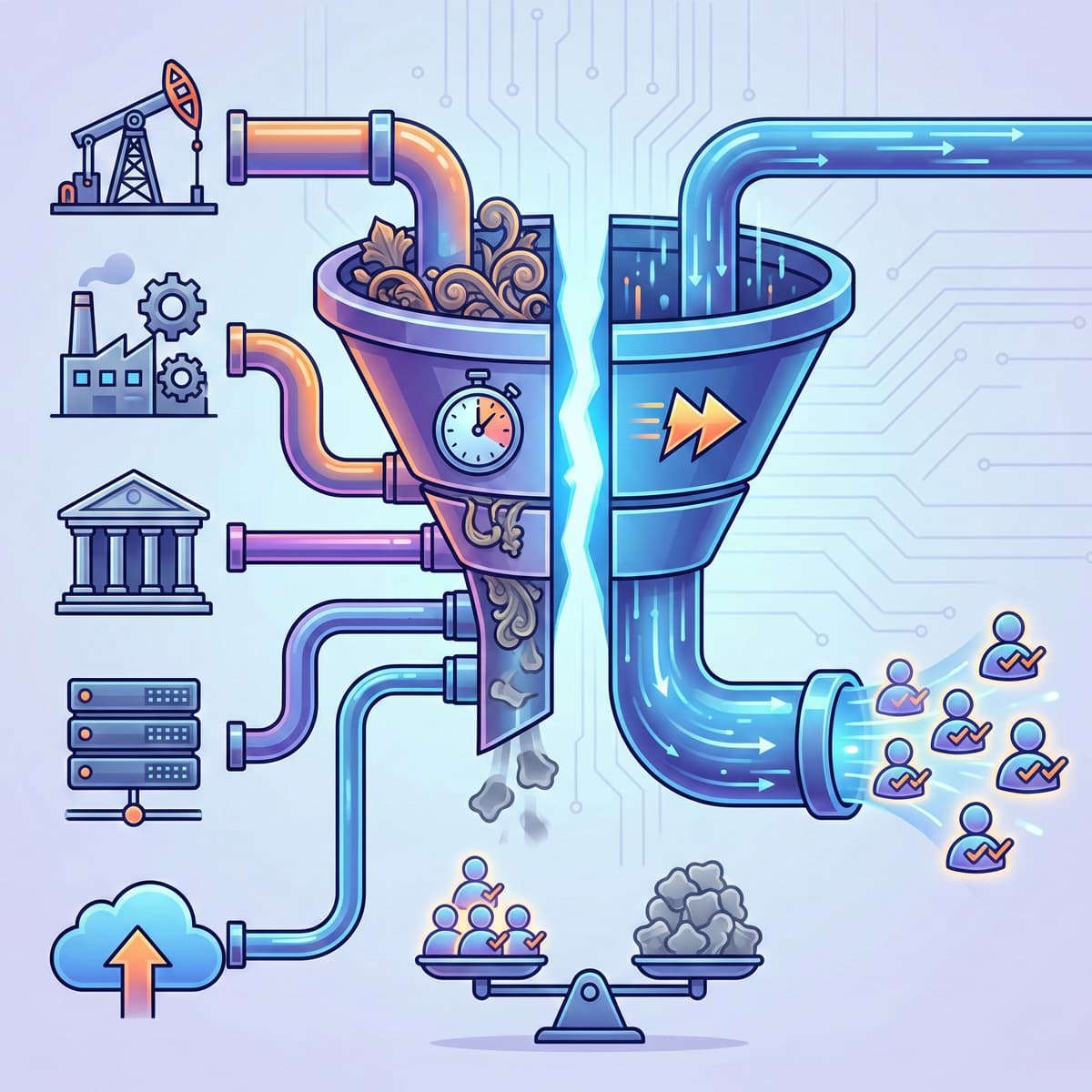
Three teams. One system causing problems for all of them. The system is the traditional, monolithic CMS, where the content management, the business logic, and the frontend presentation are all welded together into a single application.
Headless CMS is the architectural decision to unweld them.
What "headless" actually means
I'm going to explain this without buzzwords because the concept is simpler than the industry makes it sound.
A traditional CMS like WordPress does two jobs at once. Job one: let editors write and organise content. Job two: render that content as web pages and serve it to visitors. Both jobs happen inside the same application, on the same server.
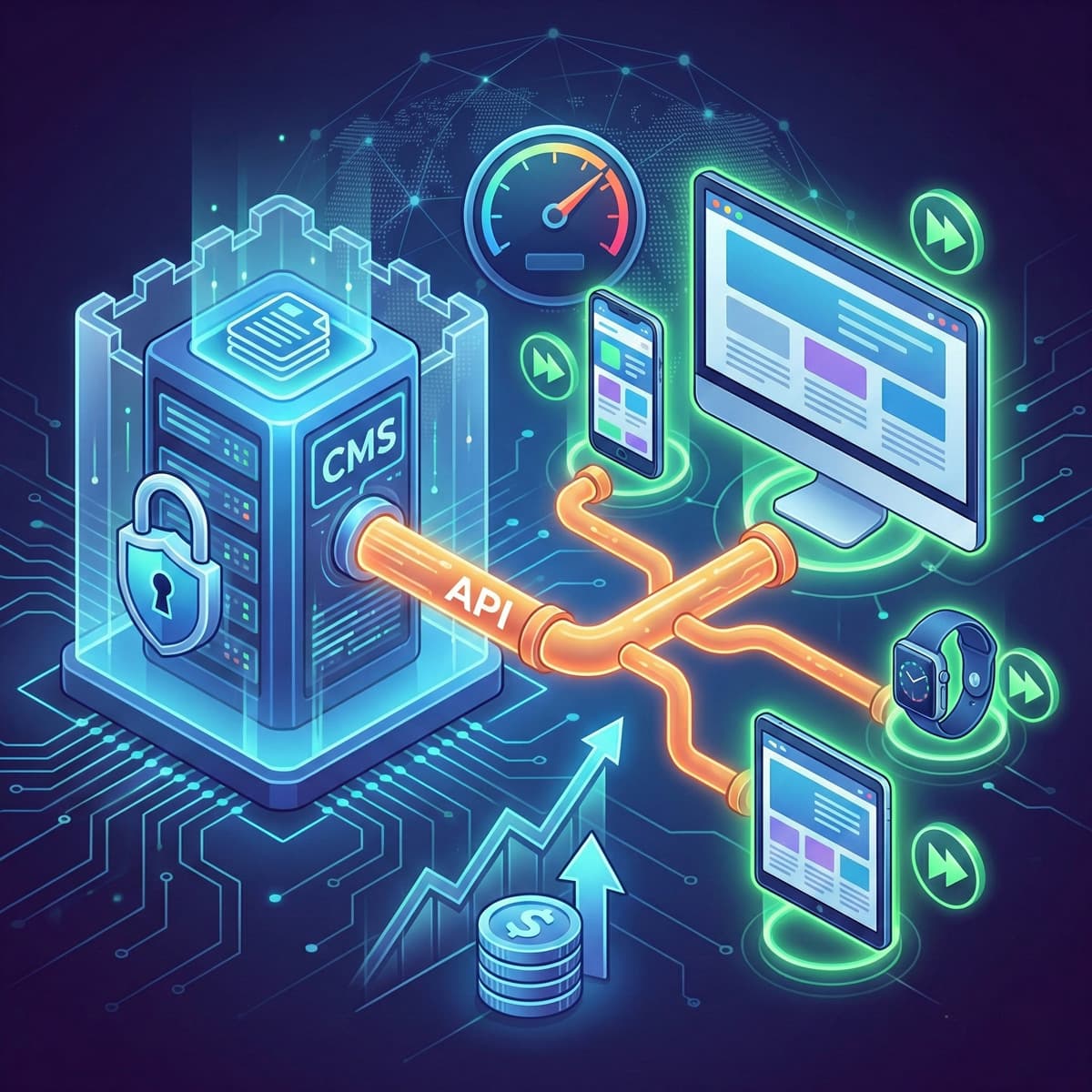
A headless CMS splits those two jobs apart. The CMS still handles content editing. But instead of rendering web pages itself, it makes the content available through an API. A separate frontend application (built with Next.js, React, or whatever you prefer) fetches that content and handles the rendering.
That's it. The "head" (the frontend) is removed from the "body" (the CMS). Hence "headless."
The practical result: your editors work in one system. Your visitors experience a completely different system. When one needs updating, the other isn't affected.
The $22 billion bet
The headless CMS market was valued at $3.94 billion in 2026 and is projected to reach $22.28 billion by 2034. That's a compound annual growth rate above 21%.
Those aren't speculative projections about some theoretical technology. This is money flowing into architecture that more than 60% of enterprise businesses are already using. The shift happened quietly (no big announcement, no industry conference keynote moment) and now it's the default approach for any enterprise web project with serious performance or scale requirements.
The reason the money is moving is straightforward. Traditional CMS platforms have scaling problems that headless architectures don't. When your content needs to feed a website, a mobile app, a partner portal, digital signage, and internal tools, a monolithic CMS starts to creak. A headless CMS serves all of those channels from a single content source through APIs. No duplication. No content drift between channels.
The speed case
This is where it gets tangible.
Next.js powers 45% of production React applications globally. It's the dominant framework for headless frontend builds, and there's a reason: it's fast.
With Static Site Generation (SSG), Next.js pre-renders your pages at build time. When a visitor requests a page, they get pre-built HTML served from a CDN. No server-side processing, no database queries. Load times drop to sub-second.
With Incremental Static Regeneration (ISR), you get the best of both worlds. Pages are statically generated but can be updated without a full rebuild. Your marketing team publishes a blog post and it's live in minutes, served statically to every visitor worldwide.
We covered the technical details in our Next.js performance optimization guide, but the business impact is what matters here. A site that loads in under a second converts measurably better than one that takes 3-4 seconds. For enterprise sites with tens of thousands of monthly visitors, that conversion difference translates directly into revenue.
If your current CMS-rendered site scores below 70 on Google PageSpeed, a headless frontend will probably get you above 90. We've seen that jump consistently. Core Web Vitals improve across the board because you're no longer fighting against a monolithic backend that processes every page request in real time.
The security case
81% of organisations plan to adopt zero-trust security frameworks by 2026. Zero-trust means no implicit trust for any user, device, or system. Every access request is verified independently.
Headless architecture fits this model naturally, because the CMS and the frontend are already separate systems.
In a traditional CMS setup, your content editor and your public-facing website share the same application and often the same server. A vulnerability in a plugin exposes the entire stack. A brute-force attack on the admin login is attacking the same system that serves your homepage.
In a headless setup, the CMS sits behind a VPN or private network. It's not publicly accessible. The only thing exposed to the internet is the static frontend: pre-rendered HTML with no server-side processing, no admin panel, no database connection. The attack surface shrinks dramatically.
Decoupling eliminates roughly 60-70% of the security attack surface that comes with traditional CMS platforms. No public-facing admin login. No plugin execution on the live server. The two systems communicate through authenticated API calls, and that API can be locked down to specific origins and authentication tokens.
For companies in regulated industries like oil and gas, financial services, or hospitality, this matters. Audit trails are cleaner because the content system and the delivery system have separate logs. And you can apply different security policies to each system independently, which makes compliance reviews considerably less painful.
The scale case
Enterprise companies rarely have just a website. They have a website, possibly multiple regional versions, a mobile app, a partner portal, an intranet, digital signage at events or retail locations, and internal documentation.
In a traditional CMS world, each of those channels either pulls from its own content source (creating drift and inconsistency) or depends on the same monolithic system (creating bottlenecks and single points of failure).
Headless CMS handles this cleanly. One content source feeds every channel through APIs. The marketing team writes a product description once. The website displays it with one design. The mobile app displays it with another. The partner portal shows a version with different pricing. All from the same source of truth.
Multi-region? Different frontends for different markets, same content backend. Multi-language? Content translation workflows in the CMS, rendered appropriately by each frontend. You don't duplicate infrastructure for each channel. You add a new frontend.
The WordPress + Next.js combination
I want to address this specifically because most of our enterprise clients use WordPress, and the first question is always: "Do we have to abandon WordPress?"
No. WordPress is one of the best headless CMS options available, precisely because your editors already know how to use it.
The setup: WordPress runs as a content backend, accessible only to your editorial team. The WordPress REST API (or WPGraphQL) exposes content to a Next.js frontend that handles everything visitors see. WordPress does what it's good at: content editing. Next.js does what it's good at: fast, modern rendering.
We've covered the React vs WordPress decision in detail elsewhere, and the headless WordPress approach keeps coming up as the right answer for companies that want modern performance without forcing their team to learn a new content editing tool.
Our modern WordPress stack runs on this exact principle. The WordPress backend is containerised and secured. The Next.js frontend is deployed to edge servers worldwide. The two communicate through APIs. Each can be updated, scaled, or maintained independently.
Who should not go headless
Honesty is important here. Headless is not the right choice for every project.
If you're a small business with a 10-page marketing site and no plans to expand to mobile apps or multi-channel content delivery, a traditional WordPress site is simpler, cheaper, and perfectly adequate. The overhead of maintaining two systems (CMS + frontend) isn't justified when a single system handles everything you need.
If your team doesn't include developers or access to a development partner, headless creates a dependency you might not want. Traditional CMS platforms let non-technical users handle most changes. Headless frontends require development skills for design changes, new page templates, and functional updates.
If editorial speed is your only priority and your content team publishes dozens of pages daily, some headless setups add friction to the preview-and-publish workflow. This has improved significantly (live preview in headless WordPress is much better than it was two years ago) but it's still not as seamless as traditional WordPress's built-in preview.
The sweet spot for headless: enterprise companies with multiple content channels, performance requirements, security concerns, and a development team (internal or external) to build and maintain the frontend. If that describes your situation, headless is almost certainly the right architecture.
The bottom line
The headless CMS market isn't growing at 21% per year because it's fashionable. It's growing because the traditional model of content management creates structural problems (slow load times, security exposure, content silos, developer bottlenecks) that headless architecture eliminates by design.
If your enterprise is still running a monolithic CMS that's eating 75% of your IT budget in maintenance, headless is the most practical first step toward modern architecture. Your editors keep their familiar tools. Your visitors get a faster site. And your security team sleeps better at night.
Not a revolution. Just better plumbing.
Related reading
- Next.js performance optimization: a complete guide -- The technical details of building a fast headless frontend.
- React vs WordPress in 2026: which is right for your website? -- The technology decision that often leads to headless.
- A modern WordPress stack: how we run fast, secure sites -- The containerised infrastructure that powers our headless builds.
- Core Web Vitals for non-developers -- The performance metrics that headless architecture improves.
- 75% of your IT budget is maintaining yesterday's website -- The problem that headless solves.