
Results
About the project
A hyper-local content and directory engine for greater Cape Town, kept current by an automated editorial pipeline and monetised through a self-serve business directory on WooCommerce.
Technologies
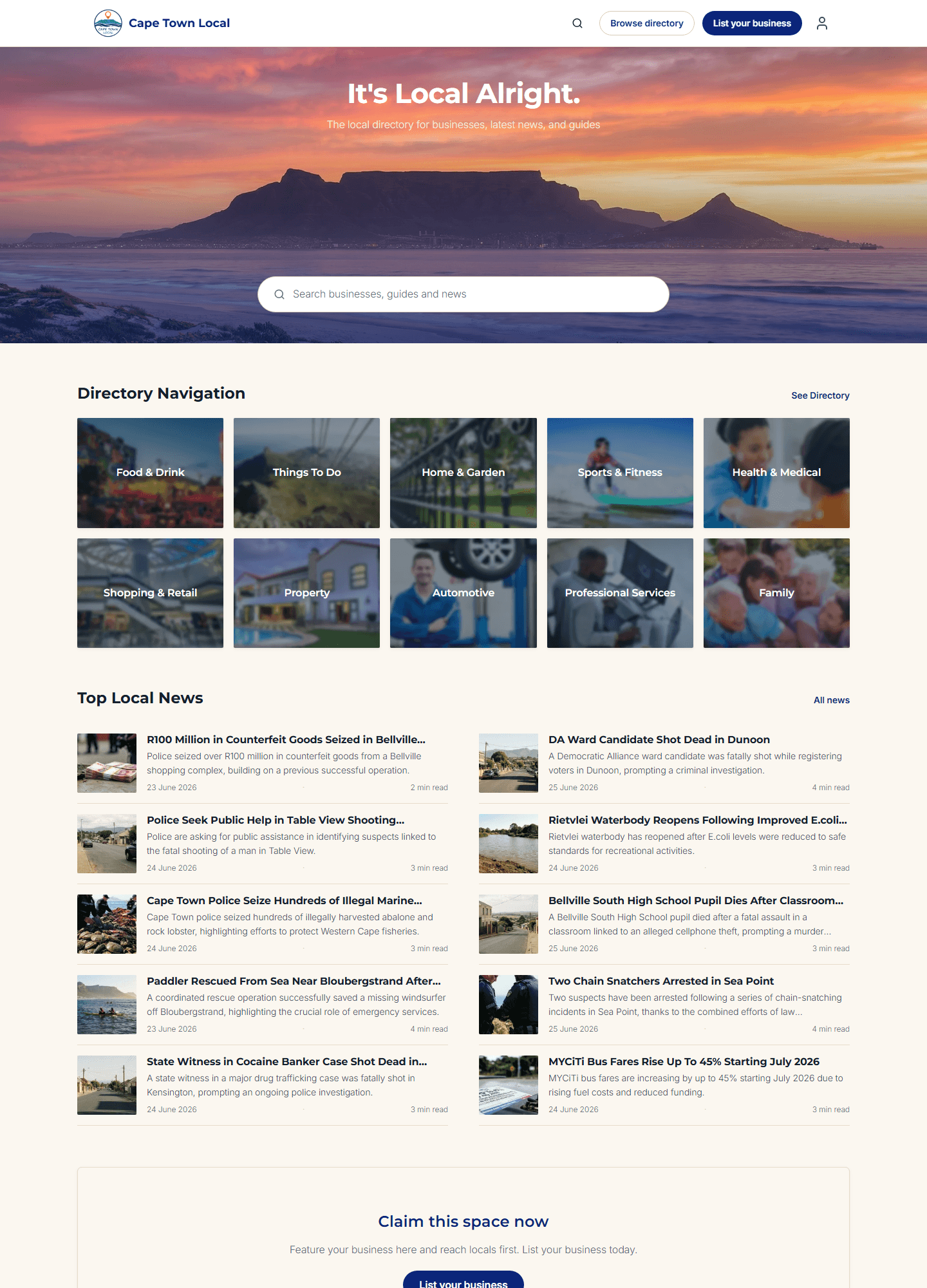
Cape Town Local (bloubergstrand.co.za) is a hyper-local content and directory engine for the greater Cape Town metro. Coverage starts on the West Coast seaboard, Blouberg, Table View, Melkbosstrand and Milnerton, and expands outward into the northern suburbs. The goal is simple to say and hard to build: become the place locals check for what is on, where to go and who to call, then let local businesses list and promote themselves directly.
The first TurboPress build, it had to do two things at once. Stay genuinely current without a newsroom, and carry a directory that can pay for itself as traffic grows.
The hard part of any local content site is keeping it fed. Cape Town Local runs an automated editorial pipeline built on n8n that drafts local news and area guides on a schedule. It uses a tiered model strategy: inexpensive local language models handle the high-volume work of gating and drafting, and a stronger editorial model runs the final taste and polish pass, so quality stays high without paying premium rates on every item.
Three guards keep the output trustworthy. A locality gate holds coverage to the greater Cape Town metro rather than national noise. A sorting office re-files each story under the right topic instead of dropping it. A semantic similarity guard, backed by vector search, merges duplicate coverage of the same story into one post rather than publishing near-duplicates.
Every article ships with machine-readable SEO baked in: structured data for articles, FAQs, breadcrumbs and local businesses, plus key take-aways, an automatic table of contents and per-image attribution. Featured imagery is generated to suit each story.
Beyond editorial, Cape Town Local is a real directory. Each business is a structured record with per-category fields and repeatable modules for locations, events and specials, every one emitting its own structured data so a listing is both easy to read and easy for search engines to understand. Owners can claim their listing and manage it from a front-end account, with sensitive edits routed through moderation.
The business model runs on WooCommerce and WooCommerce Subscriptions. Businesses self-list and upgrade to recurring Premium placements, and a custom entitlements layer turns each purchase into real on-page perks: featured placement, sponsored modules and ad slots that appear only while the placement is active. Recurring billing is configured for the South African market, with monthly and annual options.
A directory that earns from recurring revenue is far harder to measure than a one-off store, so the analytics were designed in from the start, built to hold up under South African consent rules and the realities of subscriptions.
Consent comes first. Google Consent Mode v2 is wired through a POPIA-aware consent banner, so analytics and advertising storage stay denied until a visitor opts in, with cookieless modelling filling the gaps. On top of that sits a Google Analytics 4 and Tag Manager layer that follows the entire journey as enhanced ecommerce events rather than raw pageviews: reading a local article, opening a listing, starting the claim-your-business flow, reaching checkout, and converting to a recurring Premium plan. Drop-off at each step is visible instead of guessed.
Behind the analytics, entitlements are the source of truth. Every purchase writes to a window-aware placements ledger keyed by the subscription, so what a business shows on the page, featured placement, sponsored modules and directory prominence, always matches what it has actually paid for, and access sweeps off automatically when a plan lapses. Each listing and article also carries its own first-party view counter that feeds the most-viewed-first ranking across related rails, a privacy-friendly signal that keeps working even when a visitor declines cookies. The directory's own ad slots record their impressions and clicks first-party as well, so sponsored businesses get a direct read on reach and engagement without depending on a third-party ad network.
Under the editorial and commerce features sits a lean WordPress block theme, a child of Twenty Twenty-Five, with a minimal plugin footprint and server-rendered structured blocks rather than a page builder. The payoff shows in the numbers. Tested from Johannesburg, the live site scores a GTmetrix Grade A at 98 percent, with a sub-second Largest Contentful Paint of 0.7 seconds, a Time To First Byte of 216 milliseconds from the South African edge, and a Cumulative Layout Shift of 0.0002, which is effectively no visible shifting at all.
Cape Town Local launched as a portal that largely keeps itself current, with a directory ready to monetise as the audience grows. It set the template for how TurboPress builds: automate the repetitive work, keep the stack lean, and let performance and structured data do the heavy lifting for SEO.
Every project deserves this level of craft. Tell us about yours.
Practical web performance, conversion, and SEO insights for WordPress and WooCommerce sites. Monthly. No filler.