Key takeaways
- A R50/month shared hosting plan collapsed under Black Friday traffic, taking R400,000 in direct sales with it
- The outdated plugin that 'still worked' became the backdoor for a full site compromise
- No staging environment meant a rushed fix broke the checkout entirely
- The real cost wasn't just the weekend - it was 8 months of SEO rankings and customer trust
- R50,000 in prevention would have saved R1,200,000 in losses
Foreword
I debated whether to publish this.
The business owner at the center of this story didn't ask to be a cautionary tale. They built something real - a brand with loyal customers, a product people loved, and a team that worked hard. They weren't lazy or stupid. They were busy, growing, and trusted that "good enough" was good enough.
It wasn't.
I'm sharing this - anonymized, with their permission - because the lessons are too important to keep private. Every decision described here, I've seen other store owners make. The path to disaster isn't dramatic; it's gradual. It's a thousand small compromises that feel reasonable at the time.
This is the story of how a R2,000,000 sales weekend became a R1,200,000 loss.
The Setup: Meet "Urban Threads"
Urban Threads (not their real name) sells premium streetwear online. Started in a garage, grown to 15 employees, R800,000 in monthly revenue. A proper South African ecommerce success story.
Their Black Friday strategy was aggressive:
- 40% site-wide sale
- R500,000 marketing budget (influencers, Meta ads, Google Shopping)
- Projected sales: R2,000,000 in 72 hours
The team had prepared for weeks. Inventory was stocked. Customer service was staffed. The hype was building.
What they hadn't prepared for was what was running under the hood.
The Infrastructure (A House of Cards)
Here's what I discovered when I was called in - too late - to do the post-mortem:
Hosting: R89/month Shared Plan
Urban Threads was running their R800,000/month business on a budget shared hosting plan. The same type of host that also runs hobby blogs and student projects.
- Allocated Resources: 1 CPU core (shared), 2GB RAM (shared)
- PHP Workers: 2
- Database: On the same congested server as 200+ other websites
During normal traffic, this... worked. Pages loaded in 4-5 seconds (slow, but functional). Orders processed. The admin panel was sluggish, but everyone assumed that was just "how WordPress is."
The hosting plan cost R1,068 per year.
The Plugin Graveyard
Urban Threads had 47 plugins installed. Of those:
- 12 hadn't been updated in over a year
- 3 had been abandoned by their developers
- 1 had a known critical vulnerability (CVSSv3 9.8) with a public exploit
That last one was a slider plugin. The marketing team had insisted on keeping it because "the new one doesn't do the same transitions."
The vulnerability allowed unauthenticated remote code execution. Anyone could run arbitrary PHP on the server. It had been public knowledge for 18 months.
No Staging, No Backups, No Monitoring
- Staging environment? "We just test on live, it's faster."
- Automated backups? "The host says they do weekly backups."
- Uptime monitoring? "We check the site in the morning."
- Security scanning? "We have WordFence."
WordFence was installed, but the license had expired 8 months prior. It was running an outdated signature database and sending unread email alerts to a no-longer-monitored inbox.
Thursday Night: The First Warning
The store's marketing push began Thursday at 6 PM. Email blast to 45,000 subscribers. Social posts announcing the sale. Paid ads activated.
Traffic spiked immediately - from 200 concurrent visitors to 2,000.
The server buckled.
7:15 PM: Checkout Timeouts
Customers adding items to carts were met with spinning wheels. The "Place Order" button would hang for 45 seconds before showing an error:
"There was a problem processing your order. Please try again."
The 2 PHP workers couldn't handle the load. Each checkout requires:
- Cart validation
- Stock reservation
- Payment gateway communication
- Order record creation
- Email triggers
When 50 customers hit checkout simultaneously, 48 of them were stuck waiting. Most left.
Lost sales estimate (Thursday evening): R85,000
9:30 PM: "Let's Just Restart the Server"
The founder - let's call him Thabo - logged into the hosting control panel and restarted the server. This temporarily cleared the queue.
For 20 minutes, things worked. Then the backlog rebuilt.
Thabo submitted a support ticket to the hosting company: "Site is slow, please investigate."
The response came at 11:47 PM: "Your account is using excessive resources. Please consider upgrading or optimizing your site. Ticket closed."
Black Friday: The Collapse
The big day. R2,000,000 in projected sales. The team arrived at 6 AM to monitor.
6:00 AM - 8:00 AM: Slow but Working
Early morning traffic was manageable. Orders trickled in. The team felt cautiously optimistic.
9:00 AM: The Flood
Television coverage of Black Friday deals aired a segment featuring Urban Threads (arranged by PR weeks earlier). Traffic exploded from 1,500 to 8,000 concurrent visitors in 15 minutes.
The server didn't just slow down. It died.
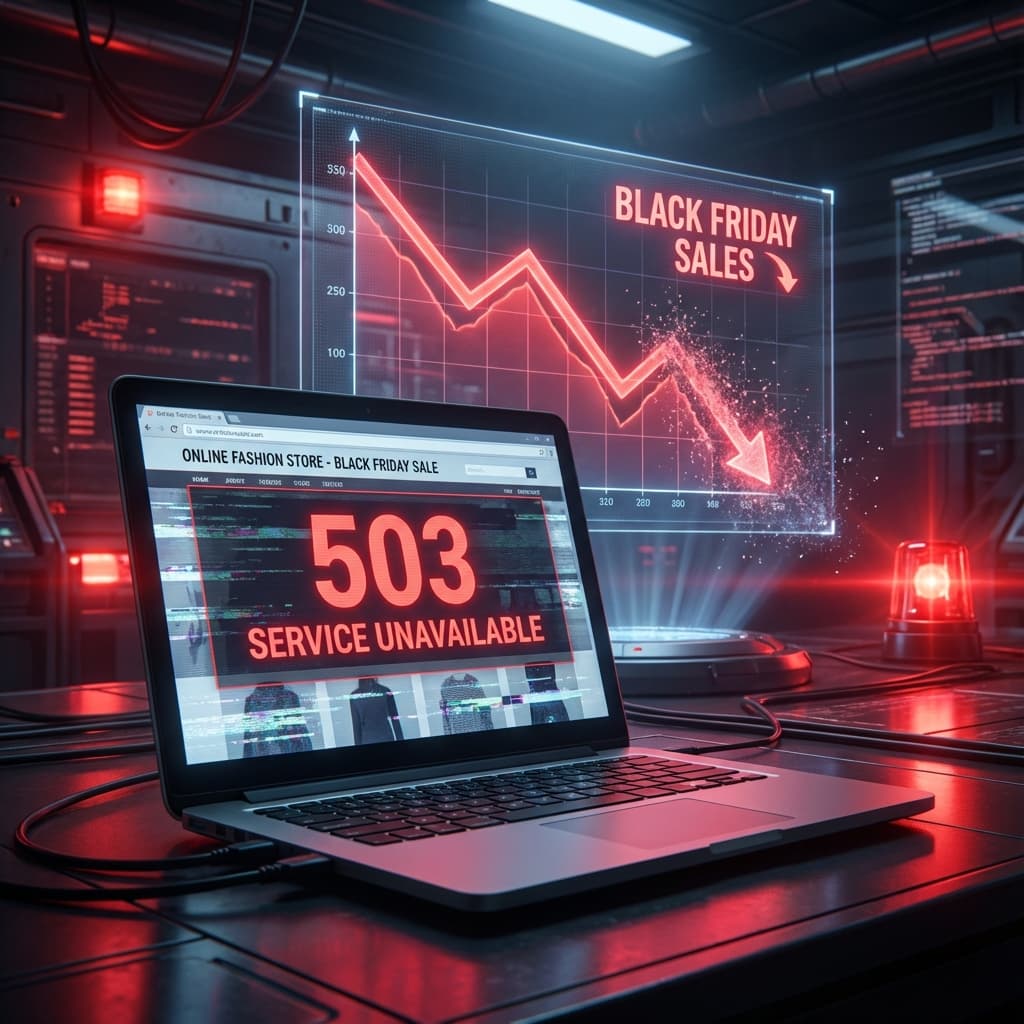
Error 503: Service Unavailable
The hosting company's automated systems had throttled the account for "resource abuse."
9:45 AM: Panic Mode
Thabo called the hosting support line. After 35 minutes on hold, a support agent explained the situation:
"Your account has been rate-limited because it's consuming too many resources. You'll need to reduce traffic or upgrade to a VPS plan."
"How long to set up a VPS?"
"Our migration team typically schedules that within 3-5 business days."
It was Black Friday.
10:30 AM: The Emergency Migration
Thabo found my number through a mutual contact. His voicemail was frantic.
I assessed the situation in 15 minutes and gave him two options:
- Wait for hosting to unthrottle: Unknown timeline, likely not before Monday.
- Emergency migration to cloud infrastructure: 4-6 hours, R35,000 emergency fee.
He authorized the migration.
11:00 AM - 4:00 PM: The Sprint
I spun up a new server on Google Cloud. 8 vCPUs, 32GB RAM, SSD storage. Configured Nginx, PHP 8.2, Redis caching, and MariaDB tuning for high concurrency.
Migration began. DNS propagation started.
During this window, the storefront showed a "Maintenance Mode" page. No sales. No orders. Just a slowly updating progress bar and an apologetic message.
Lost sales estimate (Friday downtime): R320,000
4:30 PM: Back Online
The new server went live. Performance was exceptional - pages loading in under 1 second. The checkout handled 100+ concurrent orders without breaking a sweat.
But the damage was done. The Thursday email subscribers who couldn't check out didn't come back. The TV segment viewers who hit a 503 error didn't return. The momentum was shattered.
Sales Friday (post-recovery): R180,000
Projected Friday sales: R650,000
Saturday Morning: The Discovery
At 2 AM Saturday, an automated security scan I'd configured flagged anomalies.
Malicious files. Seventeen of them. Scattered across the installation.
The slider plugin vulnerability had been exploited - not that weekend, but months earlier. Attackers had been living in the system, waiting. On Black Friday, with the chaos of migration, their payload activated.
What They'd Done
-
Injected a card skimmer into the checkout flow. Every order during Thursday evening's brief operational window had payment details captured.
-
Created hidden admin accounts set to activate 48 hours after detection (a dead man's switch).
-
Planted webshells in the uploads directory, allowing future access even if the original backdoor was removed.
-
Modified WooCommerce core files to redirect 10% of mobile traffic to a phishing clone of the site.
The attack was sophisticated, patient, and professional. This wasn't script kiddies - it was organized crime.
The Remediation
Saturday through Sunday was crisis management:
Immediate Actions
- Site offline again for security cleanup.
- Full forensic backup preserved for legal/insurance purposes.
- Clean install of WordPress, WooCommerce, and all plugins from verified sources.
- Database sanitization removing all malicious entries.
- Password reset for all users, API keys rotated, payment credentials regenerated.
Notifications Sent
- Payment processor: Alerted to potential card data compromise.
- Affected customers: Email notification of security incident.
- Information Regulator: POPIA-mandated breach report.
Timeline
- Friday 4:30 PM - Saturday 2 AM: Site operational but compromised.
- Saturday 2 AM - Sunday 6 PM: Site offline for cleanup.
- Sunday 6 PM: Site relaunched with hardened security.
Lost sales (Saturday-Sunday downtime): R280,000
The Total Damage
Let me add it all up:
Direct Revenue Losses
| Period | Lost Sales |
|---|---|
| Thursday evening (timeouts) | R85,000 |
| Friday (downtime) | R320,000 |
| Friday (reduced post-recovery) | R470,000 |
| Saturday-Sunday (security cleanup) | R280,000 |
| Direct Lost Sales | R1,155,000 |
Additional Costs
| Item | Cost |
|---|---|
| Emergency migration fee | R35,000 |
| Security forensics & cleanup | R55,000 |
| Legal consultation (POPIA) | R25,000 |
| PCI assessment (triggered by skimmer) | R180,000 |
| Staff overtime (crisis weekend) | R15,000 |
| Additional Costs | R310,000 |
The Intangible Losses
| Factor | Estimated Impact |
|---|---|
| Customer trust erosion | -15% recurring revenue |
| Google ranking drop (site instability) | -40% organic traffic (2 months) |
| Negative social media mentions | Immeasurable |
| Team morale and founder stress | Immeasurable |
Grand Total
Conservative estimate: R1,200,000+ in combined losses
What was supposed to be a R2,000,000 weekend became a financial and emotional catastrophe that took 8 months to fully recover from.
What Should Have Happened
Let me rewind and show you the alternate timeline:
3 Months Before Black Friday
Proper Infrastructure Setup:
- Cloud hosting sized for peak traffic: R3,500/month
- Redis caching and database optimization
- CDN for global asset delivery
- Staged environments for testing
Cost: R50,000 for setup, R5,000/month ongoing
2 Months Before
Security Audit:
- Plugin inventory and vulnerability scan
- Removal of abandoned/outdated plugins (including that slider)
- File integrity monitoring implemented
- Proper backup system with daily off-site copies
Cost: R15,000 one-time audit
1 Month Before
Load Testing:
- Simulated 10,000 concurrent users
- Identified bottlenecks before real traffic exposed them
- Checkout flow stress-tested
- Payment gateway verified under load
Cost: R8,000
Black Friday Weekend (Alternate Reality)
- Site handles 15,000 concurrent visitors without breaking a sweat.
- Security monitoring catches zero incidents because vulnerabilities were patched.
- Sales hit R2,100,000, exceeding projections.
- Thabo sends a grateful "thank you" message instead of a panicked voicemail.
Cost: R73,000 + R5,000/month hosting
Return: R2,100,000 Black Friday sales
ROI: 2,776%
The Lesson
Urban Threads survived. Barely.
It took 8 months to rebuild customer trust. It took painful cost-cutting to absorb the losses. Thabo told me later that he almost closed the business in February - the financial and emotional weight nearly broke him.
He's now a client. We rebuilt his infrastructure properly. Black Friday the following year generated R2,400,000 with zero downtime.
But he'll tell you himself: he'd give anything to have those 8 months back.
The Decision Point
You're reading this, and you're thinking about your own store.
Maybe you're on that R89/month host. Maybe you've got plugins you haven't updated because "they still work." Maybe your last backup was... you're not actually sure.
You have two choices:
-
Address it now. Audit your infrastructure. Fix the vulnerabilities. Build systems that can handle success.
-
Wait. Hope it doesn't happen to you. Roll the dice.
I know what Urban Threads would tell you.
Closing Thought
Every time I share stories like this - and I have too many of them - business owners tell me the same thing:
"I never want to be that guy."
Then do something about it. Today. Before your Black Friday comes.
Because the attackers aren't waiting. The traffic spikes don't schedule themselves. And hosting companies don't hand out refunds for lost sales.
The best time to secure your store was a year ago. The second best time is right now.
Related reading
- The WooCommerce security stack that actually works. The defenses that would have prevented Urban Threads' security breach.
- Scaling WooCommerce: what changes when you hit 10,000+ monthly visitors. How to prepare your infrastructure before the traffic arrives.
- What happens when your WooCommerce store gets hacked. The full cost breakdown of a breach, beyond just the Black Friday losses.